
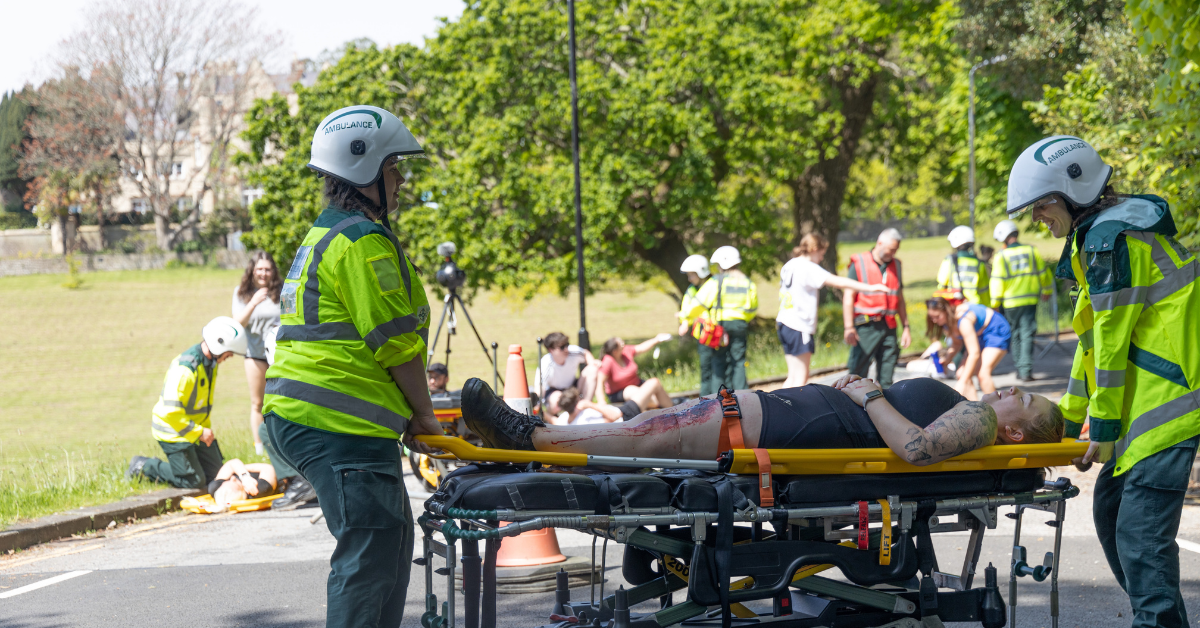
We spoke to Swansea University Senior Lecturer in Paramedic Science, Matt Waters BSc (hons), PGCE, PGCert HE, FHEA, MCPara, about his recent work with our Simulation and Immersive Learning Centre (SUSIM).
After more than a decade as a paramedic – including a leadership role with South Western Ambulance Service’s Hazardous Area Response Team (HART) – Matt transitioned into academia as a Lecturer in Paramedic Science at Swansea University. His teaching is informed by extensive operational experience, with a focus on preparing future paramedics for the evolving demands of pre-hospital care.
As part of his PhD with SUSIM, Matt is investigating the role and impact of simulation-based learning (SBL) within paramedic education. His research explores how the design, delivery, and implementation of simulation influence student competence, confidence, and teamwork in high-pressure environments.
A key focus of his work lies in understanding the non-clinical dimensions of paramedic practice, such as leadership, decision-making, and communication, which are vital to effective performance during major incidents. By analysing how teams collaborate and adapt under stress, his research contributes to the development of more resilient and responsive paramedic systems.
Matt’s evaluation methods combine structured observation, participant feedback, and pre- and post-simulation assessments to measure clinical outcomes and learner engagement. His findings aim to define what makes a simulation both educationally effective and operationally authentic – improving preparedness while fostering reflection and confidence.
Recognising the limits of simulation compared to real-world experience, Matt’s PhD also examines how fidelity, debriefing, and scenario realism can be enhanced. By refining these factors, his work seeks to close the gap between simulated training and on-scene performance, ensuring skills are transferable to real emergencies.
Emerging tech such as virtual reality (VR), augmented reality (AR), and high-fidelity manikins play a growing role in his research. These tools offer immersive, repeatable, and safe learning environments that replicate the complexity of real incidents, supporting the next generation of evidence-based paramedic training.
Looking ahead, Matt plans to translate his findings into practical improvements within Swansea University’s Paramedic Science programme and beyond. Through peer-reviewed publications, national presentations, and collaboration with the Health Education and Improvement Wales (HEIW) Simulation Research Group, he aims to influence simulation practice across healthcare education.
His ultimate goal is to strengthen paramedicine as an evidence-based discipline — one that values not only clinical excellence, but also the teamwork, adaptability, and decision-making that underpin effective care in complex, high-pressure environments.
This research embodies our commitment to advancing evidence-based education and interdisciplinary collaboration that enhances health, performance, and care across the emergency and healthcare sectors.

