
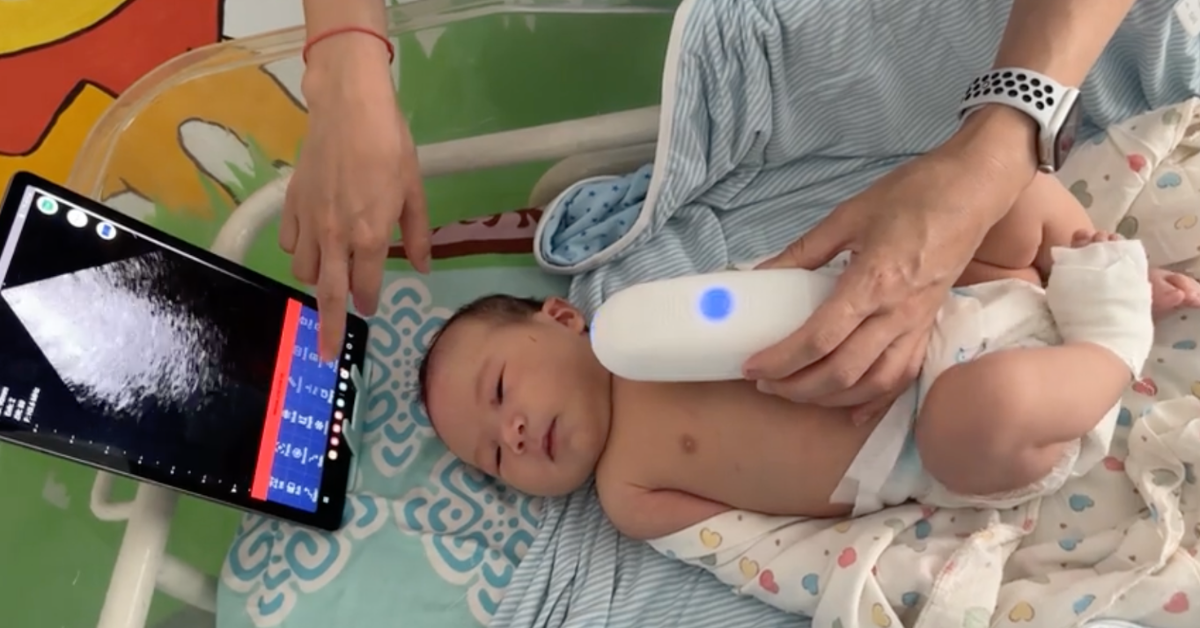
Swansea University is collaborating with US start-up company Bloom Standard, its international partners and paediatric doctors in Mongolia to support the development of a new medical device designed to improve the early diagnosis of babies born with heart defects.
The collaboration brings together clinical and innovation expertise from Swansea University, with Associate Professor of Healthcare Science Emma Rees and her colleague Dr Natalie de Mello working alongside Bloom Standard as the company develops the device.
The shared goal is to improve the early diagnosis of congenital heart defects, a condition that affects people around the world. Currently, these heart defects are usually detected using large, expensive pieces of equipment and require specialist expertise in hospital environments. This can be a challenge when babies are born in more remote areas or in locations where healthcare resources are more limited.
Bloom Standard’s vision is to develop a much smaller, self-driving ultrasound machine that can be used by non-experts in more remote locations. The aim is for the device to become part of the existing screening pathway and improve the ability to detect heart defects at a much earlier stage in childhood.
For Emma, the partnership with Bloom Standard was a natural fit. With 30 years of experience in cardiac diagnostic testing, she was able to bring clinical expertise to the project, alongside the support of Swansea University’s innovation infrastructure and the wider expertise available across the University. The shared vision is to work together to make a difference for people in Wales and globally.
The Health and Wellbeing Academy provides a bespoke heart scan lab to support the work, as well as space where industry partners can base their offices and labs alongside academics. Being co-located in this way helps create a more efficient innovation process by bringing industry and academic expertise together in one place. The project is also supporting a PhD studentship, with research focused on the development of the device and new approaches to implementation research.
This work will support the development of the current device and provide learning that can be applied to other companies developing medical devices in the future. The collaboration demonstrates how combining clinical expertise, academic research and industry experience can help support the development of new medical technologies designed to address healthcare challenges both in Wales and internationally.