
From student rugby in the 1930s to hosting the All Blacks in 2015, to a state-of-the-art Sports Innovation Centre, Swansea Bay Sports Park has witnessed almost a century of sporting history. Long-standing Swansea University Grounds Manager John Courtney talked us through this rich history as we look forward to what’s next for the area…
1920: Swansea University is founded
Swansea University, then University College Swansea, was founded in 1920. The foundation stone was laid by King George V on 19 July 1920, with 89 students enrolled. Sport was part of university life from the beginning, with rugby, football and hockey inter-collegiate competitions.
|
1930-31: The pavilion is built
The sports pavilion at Sketty Lane was designed by Swansea architect Glendinning Moxham (who also worked on the Glynn Vivian Art Gallery and the former YMCA building), and constructed between 1930 and 1931. This was the first purpose-built building associated with the newly established University.
|
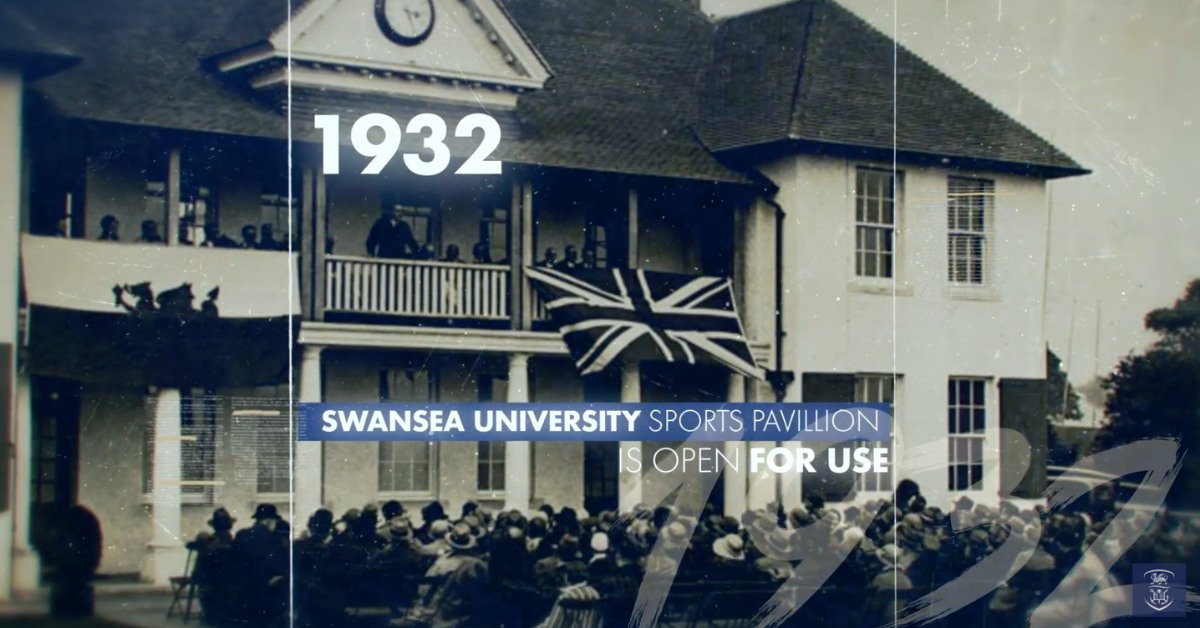
1932: The pavilion opens
The sports pavilion was officially opened in 1932. The building was grand and included changing rooms, offices, a committee room, a function room and a balcony overlooking the playing fields.
|
1930s: Swansea’s rugby golden era
The 1930s were significant for rugby at Swansea University, producing exceptional players, including Watcyn Thomas, Claude Davy, Idwal Rees and Haydn Tanner, several of whom went on to captain Wales. Haydn Tanner also became a British Lion.
At the same time, Swansea RFC had a strong connection with the University. When Swansea RFC famously defeated New Zealand 13-8 in 1935, six Swansea University students featured in the Swansea team.
|
1936: Sketty Lane becomes an established sporting base
By 1936, the University had established the Sketty Lane playing fields, expanding the sporting facilities around the pavilion. Before this, University rugby had been played on the Singleton campus and at Swansea RFC’s St Helen’s ground.
|
1950s: The pavilion grows
A sports hall and shower block were added to the rear during the 1950s, which had been anticipated in the original plans. The building evolved alongside the University’s sporting ambitions.
|
1960s-90s: Swansea’s sporting community expands
As Swansea University grew, so did its sporting programme. What began with a handful of university clubs eventually developed into dozens of sports, with the Sketty Lane facilities becoming an increasingly important part of student life and competitive sport.
Stan Addicott became Director of Sport and Physical Recreation at Swansea and was heavily involved in developing sport at the University over several decades. His work included the 1985 sports scholarship initiative, which helped support athletes towards international and Olympic success.
|
2000s: Sketty Lane becomes a major sports venue
The University continued to develop the facilities around the historic pavilion, with Sketty Lane evolving into a major park for university, community and elite sport. By the early 2010s, the site was hosting hundreds of sporting fixtures and more than 90,000 individual visits a year.
|
2010: Varsity comes to Sketty Lane
Since 2010, Sketty Lane and the pavilion have hosted a number of Varsity events, becoming part of one of Welsh university sport’s biggest traditions where Swansea come face-to-face with Cardiff University in a series of events with up to 1,400 students spectating and competing.
|
2012: Olympic connection
Swansea University hosted the Mexican and New Zealand Paralympic teams during their training camps ahead of the London 2012 Olympic and Paralympic Games. The facilities were attracting elite international athletes, even before the All Blacks arrived.
|
2014: International competition comes to Sketty Lane
The University hosted the IPC Athletics European Championships in 2014. This further established Swansea’s sports facilities as a venue capable of hosting athletes and teams competing at the highest international level.
|
2015: The All Blacks arrive
Swansea University became a team base for the 2015 Rugby World Cup, hosting Fiji and Canada, before the reigning world champions, New Zealand’s All Blacks, arrived in October. The University records that the All Blacks used the sports pavilion, gym and rugby pitches while preparing for their quarter-final against France, training in Swansea ahead of their quarter-final at the Millennium Stadium. Dan Carter even shared a photo of Swansea Bay from his hotel room, which was seen around the world.
The All Blacks also visited Swansea RFC, where coach Steve Hansen presented them with a signed 2015 All Blacks jersey in recognition of their hospitality.
|
2016: World University Rugby Sevens
In July 2016, the Sports Park hosted the World University Rugby Sevens Championships, bringing university rugby teams from around the world to Swansea Bay Sports Park.
|
2017: International Veterans Tournament
In 2017, Sketty Lane hosted an international Veterans 5-a-side World Cup tournament, with teams from Canada, Qatar, Turkey, Europe and elsewhere, and the pavilion itself was used for associated health/sport science displays and presentations
|
2020: 100 years of sport
Swansea University celebrated its centenary in 2020, producing a 100 Years of Sport retrospective to highlight how sport had developed from those early competitions into a programme encompassing more than 50 clubs.
|
2022: A Century of Sport is published
Stan Addicott published his book A Century of Sport at Swansea University 1920–2020, documenting 100 years of sporting achievement at the University. Stan was Swansea University’s former Director of Sport and had decades of first-hand involvement with the University’s sporting community.
|
2026: The next chapter
After almost a century of service, the historic pavilion is now being replaced as part of the redevelopment of the Sketty Lane site.
The existing pavilion and ancillary buildings have been removed to make way for a new four-storey Life Sciences and Sport Innovation building, linking the University’s expertise in sport, health, wellbeing and life sciences.
Our new facility is part of Swansea University’s wider ambition to be a leader in Sport and Health, bringing together sport, healthcare, research, innovation and industry.
If you have any stories or memories of the pavilion you’d like to share, we’d love to hear from you.